
WASHINGTON — The Biden administration is submitting its long-awaited action report on Afghanistan to Congress.
National Security Council Coordinator for Strategic Communications spokesman John Kirby announced the review at a White House briefing, where he argued that the U.S. had already degraded the terrorist threat from Afghanistan when President Joe Biden withdrew U.S. troops.
“The President's decision to end the war in Afghanistan was the right one,” Kirby said during a press briefing Thursday. "The United States had long ago accomplished its mission to remove from the battlefield the terrorists who attacked us on 9/11."
The White House released a document Thursday that blamed the Trump administration for setting the stage for the chaotic withdrawal from Afghanistan by lowering U.S. troop levels there and negotiating with the Taliban without consulting allies or the Afghan government.
“President Biden’s choices for how to execute a withdrawal from Afghanistan were severely constrained by conditions created by his predecessor,” the statement says.
Three documents are expected to be released soon by the Pentagon, according to Capitol Hill aide familiar with the process but not authorized to speak publicly.
Congress expects to receive a classified version of the report Thursday, the aide said. A memo from Defense Secretary Lloyd Austin describing the report may also be released, along with an unclassified version.
In a statement, Austin said the Pentagon planned to provide congressional oversight committees the Pentagon's after-action review of U.S. policy in Afghanistan from the beginning of the Biden administration through the withdrawal in August 2021.
The unclassified document that will be made available publicly will include the "broad strokes" of what the administration learned and how it's putting the information to use, Kirby said.
'A self-inflicted wound': US withdrawal from Afghanistan still haunts Biden's presidency one year later

The Taliban bars Afghan girls from school.:Inside their secret classes with a teacher in the US.
A spokesperson for the House Foreign Affairs Committee, which is chaired by Texas Rep. Michael McCaul, said it expects to receive the State Department's classified version of the report this afternoon.
Three major religious holidays are converging this week and Congress is in recess, potentially complicating lawmakers' ability to immediately review the classified documents. McCaul is currently in Taiwan.
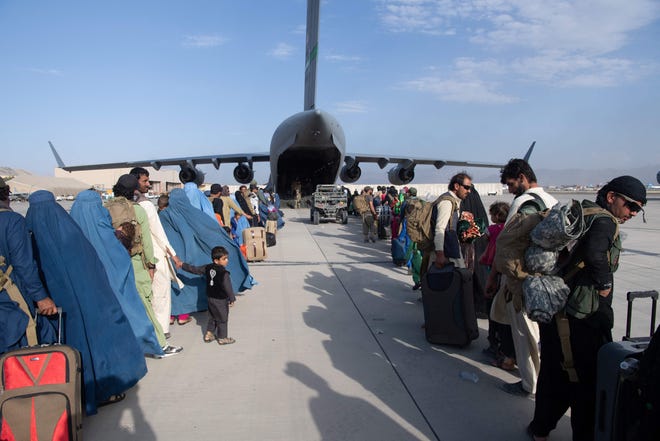
During the 20 years of war, 2,461 U.S. troops died in Afghanistan, according to the Pentagon. Amid the chaotic withdrawal and evacuation in August of 2021, 13 U.S. troops in a suicide bomber attack.
White House defends faulty intel assessment
Kirby defended U.S. intelligence assessments, but acknowledged that some of it was off target, in part due to the fluid and fast-evolving situation.
“I've yet to see an intelligence assessment that ever was 110% certain about something. They get paid to do the best they can,” Kirby said. “They'll be the first ones if they were up here to tell you that they don't always get it right. And clearly, we didn't get things right here with Afghanistan."
Among the faulty assessments were how fast the Taliban were moving across the country and "constructing these deals in the hinterlands that kind of fell like dominoes," Kirby said.
The U.S. also did not anticipate how fast Afghan national security forces would fold and the degree of corruption in the officer ranks in the military, the review determined.
Biden administration says Trump set the stage for Afghan collapse
The NSC document was particularly critical of the Trump administration’s handling of the matter, saying it set the stage for the Afghan collapse in a number of ways.
“President Biden’s choices for how to execute a withdrawal from Afghanistan were severely constrained by conditions created by his predecessor,” it said.
Singling out the former commander in chief by name, the report said Trump ordered direct talks with the Taliban “without consulting with our allies and partners or allowing the Afghan government at the negotiating table.”
In September 2019, it said, Trump emboldened the Taliban by publicly inviting them to Camp David on the anniversary of the Sept. 11, 2001 terrorist attacks on New York and Washington. Five months later, in February 2020, it said, the Trump administration struck a deal with the Taliban – known as the Doha Agreement – committing the U.S. to withdrawing all U.S. forces from Afghanistan by May 2021.
Trump further undermined the U.S. negotiating position by allowing the Taliban to participate in a peace process in which it would refrain from attacking U.S. troops and threatening Afghanistan’s major cities, “but only as long as the United States remained committed to withdraw by the agreement’s deadline,” the report said.
Trump also pressured the Afghan government to release 5,000 Taliban fighters from prison, including senior war commanders, “without securing the release of the only American hostage known to be held by the Taliban,” said the report.
“As a result, when President Biden took office on January 20, 2021,” it said, “the Taliban were in the strongest military position that they had been in since 2001, controlling or contesting nearly half of the country.”
Contributing: Rebecca Morin
Francesca Chambers is a White House Correspondent for USA TODAY. Follow her on Twitter @fran_chambers.

Source link