

Chloe Kim made history Thursday as the first woman to win two Olympic gold medals in the halfpipe. Her first run was all she needed to outdistance the field by a considerable margin. Kim joins Lindsey Jacobellis in winning gold for the USA at the 2022 Beijing Olympics.
(Looking for a recap of Wednesday's events? We've got you covered.)
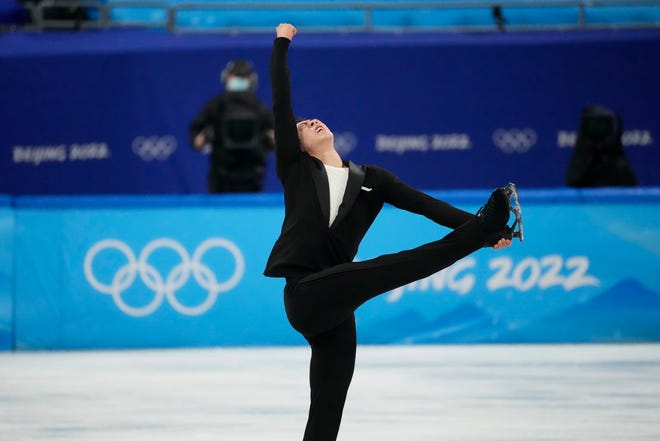
Meanwhile, Nathan Chen's quest to exorcise the demons from the 2018 Winter Olympics in Pyeongchang is nearly complete.
Following a record-breaking short program earlier this week, Chen is in position to win his first Olympic gold medal and third overall for the Americans.

TV SCHEDULE:How and what to watch Thursday
MEDAL COUNT:How each country is performing at the Winter Games
TEXT ALERTS:Sign up for behind-the-scenes access from Beijing
OLYMPIC NEWSLETTER:News and views straight to your inbox
NBC defends Shiffrin coverage, suggests sexism by critics

NBC offered a full-throated defense of how it covered Mikaela Shiffrin's shocking Olympics flameout.
NBC's cameras focused on Shiffrin for much of the time as she sat forlornly on the course, head bowed, for more than 20 minutes. The network aired a raw interview where she fought off tears and said she's second-guessing everything she's done for 15 years.
“We have an obligation in that moment, as the broadcaster of the Olympic games, to cover the moment,” Molly Solomon, executive producer of NBC's Olympics coverage, said in an interview with the Associated Press. “There's no script when there's a wipeout on the slopes or a fall in figure skating. We're watching real people with real emotions in real time and we did everything we were supposed to do.”
Shiffrin's performance was huge news, she said — the biggest story of the Games so far.
“I've thought a lot about this, and if Joe Burrow or Matthew Stafford sit on the sidelines 22 minutes after the Super Bowl on Sunday, you can bet the cameras are going to stay on them,” Solomon said.
“Here we are in 2022 and we have a double standard in coverage of women's sports,” she said. “Women's sports should be analyzed through the same lens as the men. The most famous skier in the world did not finish her two best events. So we are going to show her sitting on the hill and analyze what went wrong. You bet we are.”
Viewers tuning into NBC’s coverage expressed pity and confusion over why Shiffrin's pain was plastered on their TVs for so long.
Keith Kaufman, a clinical sports psychologist, told USA TODAY it's no surprise that "the media tends to want to focus on the drama, which may seem like it makes for good television, but it adds another layer to the distress that an athlete is experiencing."
-- Associated Press
Nathan Chen in driver's seat entering men's free skate
American figure skater and three-time world champion, Nathan Chen claimed the highest short program score ever (113.97) in international competition history Tuesday, positioning himself to thrive in the men's free skate competition in Beijing.
The 22-year-old student at Yale University was favored to win gold at the 2018 Winter Olympics in Pyeongchang, but finished 17th due to a devastating short program performance. Since then he has claimed three world championships and four national titles on his journey to Beijing.
The 24 skaters in the men's final began competition at 8:30 p.m. ET Wednesday (9:30 a.m. on Thursday in Beijing). The performances go in order of lowest to highest score, meaning Chen will skate last in the final group, a bit after 12 a.m. ET.
– Analis Bailey
Chloe Kim soars to second consecutive halfpipe gold

ZHANGJIAKOU, China – Chloe Kim has made Olympic history. The 21-year-old American won the halfpipe for a second consecutive Games, making her the first woman to win two Olympic gold medals in the event.
As she did four years ago in Pyeongchang, Kim entered as the overwhelming favorite and ran away with the competition.
Kim locked up the contest on her first run, putting down a safety score on her first lap down the halfpipe. She did a 900 and two 1080s – at that point, most riders hadn’t done one 1080 – to easily take the lead.
Kim has long stood atop her sport, but on Thursday at Genting Snow Park, she did what so many other great riders have tried. Americans Kelly Clark and Hannah Teter and Australian Torah Bright all have at least one other medal to go with their Olympic gold, but none was able to get back atop the podium.
-- Rachel Axon
Iranian skier tests positive for banned steroid
Iran’s only male athlete at the Beijing Olympics has tested positive for an anabolic steroid in the first confirmed doping case at the Games.
The International Testing Agency says Alpine skier Hossein Saveh Shemshaki failed a drug test on Monday in Beijing, before competing.
He is provisionally suspended and cannot compete at what was to be his third Olympics.
The 36-year-old raced in slalom and giant slalom at the 2010 Vancouver Olympics and four years later at Sochi. He carried Iran’s flag at the opening ceremony in Sochi.
He can appeal against his provisional ban at the Court of Arbitration for Sport in Beijing.
-- The Associated Press
Favorite for gold in women's figure skating has positive drug test

BEIJING – The medal ceremony for the Olympic figure skating team competition has been delayed by a positive drug test among the gold-medal-winning Russian team, and officials have been told that the athlete who tested positive is a minor, according to a person with knowledge of the situation who spoke to USA TODAY Sports on the condition of anonymity.
The only minor on the six-person Russian team that won gold was Kamila Valieva, 15, the gold-medal favorite in the women’s competition later in the Games.
Russian newspaper RBC reported that Valieva tested positive for trimetazidine, a heart medication that has been banned by the World Anti-Doping Agency since 2014 because it can improve endurance and blood flow.
A spokesperson for the Russian Olympic Committee has not responded to an email seeking comment.
-- Christine Brennan
Long road back to Olympics for cross-country skier Rosie Brennan
Rosie Brennan simply wasn’t feeling like herself at the Winter Olympic Games in Pyeongchang in 2018.
"I was just really exhausted all the time," said Brennan, who at age 29 had made her first U.S. Olympic team in cross country skiing, but finished 58th in the 15-kilometer skiathlon. "It was almost like an out-of-body experience."
Months later, Brennan found out she’d been suffering from mononucleosis. To add insult to illness, she was dropped by the U.S. national team for the second time due to her subpar results that season.
Brennan thought about calling it a career, but the perseverance that drives cross country skiers kept her on track.
Back for her second Winter Olympics, Brennan, 33, finished fourth in the women's sprint and 14th in the skiathlon. She hopes to compete in every women’s cross country event in Beijing.
(UPDATE: The U.S. team has been announced for Thursday's 10K classic and Brennan is on the start list -- along with two-time Olympic medalist Jessie Diggins, Hailey Swirbul, and Novie McCabe.)
– Karen Rosen
Why are Olympians in Beijing putting tape on their faces?

Athletes in Beijing are using KT Tape to protect their faces from the freezing cold temperatures, but the CEO of KT Tape Greg Venner warns that the tape isn't clinically tested for faces.
The KT Tape that athletes are putting on their faces is normally used as an elastic sports tape to provide support for muscles, ligaments and tendons to allow for full range of motion. The tape is sponsored and used by several athletes in the Beijing Winter Olympics as well as the summer Olympics season.
There's no precedent for using the tape on faces or evidence that it protects people from the cold, and Venner says that athletes should be careful about using the tape on the delicate skin on their face.
“We’ve seen KT Tape used as protection against the wind in winter sports over the years, so although it isn’t a clinically approved usage, we appreciate the ingenuity. KT Tape doesn’t endorse the use of kinesiology tape on the face as it isn’t clinically tested," Venner told USA TODAY. "However, we certainly applaud the creativity – we are proud to support Team USA!”
-- Michelle Shen
Jamaican bobsledder fights through grief to make Olympic return

BEIJING – Team Jamaica’s entrance to Friday’s opening ceremony was a joyous sight, with Jazmine Fenlator-Victorian leading a band of dancing, waving, gyrating bobsledders in unmistakably neon yellow pants.
But for Fenlator-Victorian, every moment in Beijing is a struggle between joy and grief, between the emotions pulling her home and the understanding that this is where she needs to be, between the sense of accomplishment in just getting here and the sacrifices she made to bring her third trip to the Olympics into existence.
“I’m so happy to be here and press on and share that part of my journey,” she told USA TODAY Sports. “But I’d lying if I said it wasn’t extremely difficult.”
Raised in New Jersey and now living in Texas, Fenlator-Victorian knew full well when she left Team USA after the 2014 Olympics to compete under the Jamaican flag that she was choosing the harder road. In some ways, that was the point.
– Dan Wolken
What is ROC at the Winter Olympics?
Russia's involvement in a doping scandal is once again in the spotlight for the 2022 Beijing Olympics with its athletes unable to compete under their country's name for the third Olympics in a row.
RELATED: Team medals for figure skating delayed by Russian drug test
While Russia can't participate in the games, a loophole allows its athletes to as long as they adhere to certain rules, like not wearing the Russian flag or singing the Russian national anthem.
Athletes are able to compete under the umbrella of an organization called the ROC, which stands for Russian Olympic Committee. It effectively renders the Olympic ban against Russia for its doping program to a symbolic gesture by allowing its clean athletes to still participate.
-- Michelle Shen
Figure skating will stop calling women skaters 'ladies'

In 1924, figure skating became the first sport in the Winter Olympics to allow women to compete. But though the men competed under categories for “men,” women could onlycompete under “ladies.”
Figure skating is also the last winter sport to change that naming convention: The 2022 Winter Olympics is the first to let women compete as women, not ladies. It’s a subtle change — one that audiences may miss — but a meaningful one. For a century, figure skating has clung to rigid gender rules, about everything from costumes to who can compete as a pair, that have enforced specific expectations about how athletes should look or behave. Some skaters have even reported hiding their gender identity in order to conform.
This year, more out LGBTQ skaters, including the first out nonbinary Winter Olympian, will compete in the Games than ever before. This year there will be nine openly LGBTQ figure skaters in Beijing. There were three in 2018 and none in 2014.
-- Chabeli Carrazana, The 19th
Olympic ice a proving ground for future NHL stars

When the Olympic Athletes of Russia won the gold medal in the non-NHL 2018 Pyeongchang Olympics, some prominent future NHL players were on the roster.
Forward Kirill Kaprizov, who scored the overtime winner in the gold medal game, would become NHL rookie of the year last season and an All-Star this season with the Minnesota Wild. Backup goalie Ilya Sorokin is establishing himself as the No. 1 goalie with the New York Islanders. Igor Shesterkin, the extra goalie in those Games, is a midseason favorite for the Vezina Trophy with the New York Rangers.
U.S. forward Troy Terry, meanwhile, made the NHL All-Star Game with the Anaheim Ducks during a breakout season.
The NHL won't have players at the Beijing Olympics. But with the men's hockey competition getting underway, we've identified six 2022 Olympians (three from Team USA) who could develop into key players in the NHL.
– Mike Brehm

Source link