


what can you tell us first up about what McConnell and schumer democrat republican are working out? Or I've worked out well, this is the agreement that they've worked out together. If you take a look on your screen, just at the details here, it's a two step solution. It's somewhat complicated. The first step is Congress would pass a temporary rule allowing the Senate to raise the debt limit with a simple majority. Now they still need to pass that rule with 60 republicans and democrats working together in the Senate, It's still subject to that 60 vote threshold in the Senate. The second step is once that's passed, then the democrats will set the amount of what they want to increase the debt ceiling by and then take the vote on a simple majority threshold. Now, the reason this is so difficult is because of that step one. The biggest question is, will democrats and republicans be able to work together later this week To get the 10 Republican votes in order to raise the debt limit? Remember there's 50 Democrats, 50 Republicans in the Senate, in the Senate. The vast majority of legislation requires 60 votes to pass. So that means 10 republicans will need across party lines. That was a question that was asked to Senate minority Leader mitch McConnell, Whether or not he'd be able to get 10 people from his party to join all democrats in trying to avoid this debt ceiling. This is what he had to say. Take a listen, there are always differences of opinion among republicans about how to handle a delicate issue like the debt ceiling will be voting on it thursday and I'm confident that this particular procedure will Is she enough Republican support to clear the 60 vote threshold and then later when the majority leader decides to have the procedure, it can all occur in one day and the actual debt ceiling vote will be done At a 51 vote threshold. Now the Senate is expected to take that 60 vote threshold vote later this week. Currently that vote is working its way through the House of Representatives. It only needs a simple majority there. I know there's a lot of math involved yet but we're obviously going to bring you the latest as we continue to get that the house taking its first steps right now to try and pass that so the Senate can work on it later this week. Yeah, I'm glad it's you not me following that math Nate. But these proposed solution basically requires democrats to put a number on how much money they want to raise the debt ceiling by what why the reason that republicans have shaped it this way is they want democrats to say we want to spend X number of dollars and we think that will get us through let's say the next year or so we do not know how long this debt ceiling punt is going to last for but it's required republicans are requiring democrats to set the number for how much money they expect to spend in the future. So the biggest question is going to be, what do democrats come up with as that number? Of course, republicans going to use that to play politics and say this is how much democrats want to spend. That's not exactly the full picture, though.
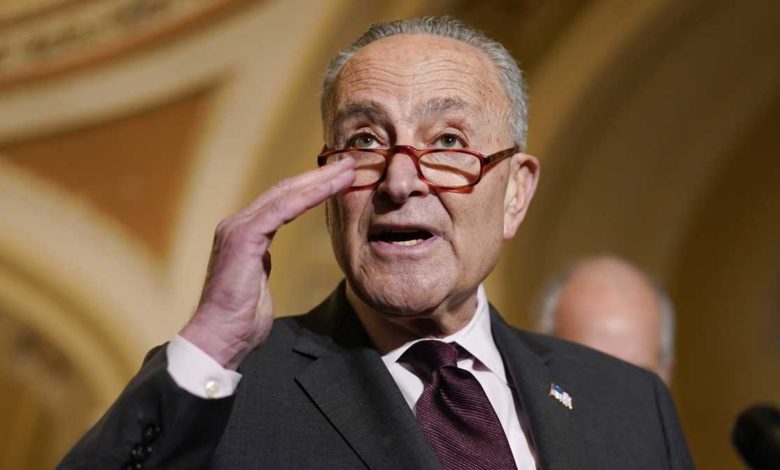
The Senate approved legislation Tuesday to lift the nation's debt limit by $2.5 trillion under a deal struck between party leaders, defusing a volatile issue until after next year's midterm elections while saddling majority Democrats with a tough vote.The 50-49 party line vote came just one day shy of a deadline set by Treasury Secretary Janet Yellen, who warned last month that she was running out of maneuvering room to avoid the nation's first-ever default. The measure now moves to the House where a vote could come as early as Tuesday night, sending it to President Joe Biden's desk."This is about paying debt accumulated by both parties, so I'm pleased Republicans and Democrats came together," Senate Majority Leader Chuck Schumer, D-N.Y., said of the agreement, which created a workaround that allowed Democrats to avoid a Republican filibuster. Despite a seemingly straightforward name, the nation's debt limit does little to curtail future debt. Established in 1917, it instead serves as a brake on spending decisions already approved by Congress and the White House — some decades ago — that if left unpaid could cripple markets, send the economy into a tailspin and shake global confidence in the U.S. That hasn't stopped Republican saber-rattling. For months, they've used the debt limit to attack Democrats' big-spending social and environmental agenda while pledging to staunchly oppose the current effort to increase the threshold. As recently as October, Senate Minority Leader Mitch McConnell said he would not "be a party to any future effort to mitigate the consequences of Democratic mismanagement."In striking a deal, McConnell backtracked on his word. But he also got much of what he wanted: Democrats taking a politically difficult vote without Republican support, while increasing the limit by a staggering dollar figure that is sure to appear in future attack ads."If they jam through another taxing and spending spree this massive debt increase will just be the beginning," the Kentucky Republican said Tuesday.The decision, however, has proven unpopular with some Republicans, particularly Donald Trump. The former president has railed against the deal repeatedly, calling McConnell a "Broken Old Crow" who "didn't have the guts to play the Debt Ceiling card, which would have given the Republicans a complete victory on virtually everything." "GET RID OF MITCH!" Trump said in a statement issued Sunday. Republican Sen. Mike Lee of Utah also criticized the intricate process Schumer and McConnell agreed to, which he warned could be used in the future to "launder" potentially unpopular votes while bypassing the Senate's normal mode of operation. Under the agreement, an amendment was made to an unrelated Medicare bill that passed last week with Republican votes. It created a one-time, fast-track process for raising the debt limit that allowed Democrats to do so with a simple majority, bypassing the 60 vote threshold to avoid a GOP filibuster.Lee said the process was intended to make the Republican votes last week "appear as something other than helping Democrats raise the debt ceiling," which he said Republican leadership "committed, in writing no less, not to do." Yet Republican arguments against debt limit increases often ignore inconvenient facts. The nation's current debt load of $28.9 trillion has been racking up for decades. Major drivers include popular spending programs, like Social Security and Medicare, interest on the debt and recent COVID-19 relief packages. But taxation is also a major factor, and a series of tax cuts enacted by Republican presidents in recent decades has added to it, too.The national debt includes $7.8 trillion heaped onto the pile during Trump's four-year presidency, an analysis of Treasury records shows. The GOP-championed 2017 tax cut is projected to add between $1 trillion and $2 trillion to the debt, according to the nonpartisan Tax Policy Center.
Senate Democrats are on track to vote on Tuesday to raise the national debt limit by $2.5 trillion and extend it into 2023 as lawmakers race to avert a catastrophic default ahead of a critical mid-week deadline.
Treasury Secretary Janet Yellen has warned that the debt limit could be reached on Dec. 15, leaving Congress little time left to resolve the issue. Once the Senate takes action, the House will next have to approve the same legislation before it can be sent to President Joe Biden to be signed into law. A first-ever default would spark economic disaster and party leaders on both sides of the aisle have made clear it must be prevented.
Senate Majority Leader Chuck Schumer said on Tuesday that the Senate will vote to raise the debt ceiling to a level that will extend the limit into 2023. The resolution that Democrats plan to vote on increases the limit by $2.5 trillion.
It had been expected that Democrats would raise the limit by an amount sufficient to ensure that the issue will not need to be addressed again until after the 2022 midterm elections.
Republicans have insisted that Democrats should take responsibility for raising the limit and do it on their own. In response to that demand from Republicans, Congress passed legislation last week to create a fast-track process that will allow Democrats to raise the debt limit on their own in the Senate without help from Republicans.
The newly created and temporary one-time process will allow Senate Democrats to take up and pass a bill to increase the debt limit by a specific dollar amount and a simple majority vote — or 51 votes if all senators are present and voting. Senate Democrats control 50 seats in the chamber and Vice President Kamala Harris can break tie votes.
Schumer announced on Monday that the vote to raise the debt limit will take place on Tuesday.
"Last week, we advanced bipartisan legislation that will enable this chamber to address the debt ceiling on a fast-track basis. For the information of all, the Senate will act tomorrow to prevent default," he said.
Source link