

Two dangerous and invasive plants are blooming across Ohio.Commonly found tighter, poison hemlock and wild parsnip could prove to be fatal or cause severe discomfort if an induvial comes into contact with them.Joe Boggs is an entomology professor at Ohio State University Extension. He said both plants are beginning to “bolt” and bloom, meaning the clock is winding down for controlling the non-native nasties.POISON HEMLOCKPoison hemlock is one of the deadliest plants in North America.The plant contains highly toxic piperidine alkaloid compounds, including coniine and gamma-coniceine, which cause respiratory failure and death in mammals. The roots are more toxic than the leaves and stems, Boggs said, but all parts of the plant — including the seeds — should be considered dangerous.The toxins must be ingested or enter through the eyes or nasal passages to induce poisoning, Boggs said.Boggs warned that the plant should not be handled because sap on the skin can be rubbed into the eyes or accidentally ingested while handling food.What should you look for? Boggs said poison hemlock produces white flowers on stalks that create a more rounded look – like an umbrella. These plants have bluish-green leaves. The deeply cut parsley-like leaflets have sharp points.Flowering plants have hairless, light-green to bluish-green stems that are covered with obvious reddish-purple blotches. But, the blotches may occasionally coalesce to cause stems to appear an almost solid color, according to Boggs.WILD PARSNIPWild Parsnip can cause severe, painful blistering, Boggs said in an article for OSU.The weeds are commonly found growing alongside poison hemlock.Wild parsnip has intense yellow flowers with the stalks producing a more flat-topped appearance.Wild parsnip plants have leaves that look vaguely like celery, another member of the carrot family. Mature plants have a single, thick, deeply grooved, greenish-yellow stem that sprouts lateral branches topped with flowers, Boggs said.Wild parsnip can cause severe blistering called phytophotodermatitis, also known as Berloque dermatitis, Boggs said, and can cause burn-like symptoms when exposed to the skin. It can also cause skin discoloration that may last for several months, the educators said in the article.Blistering can appear 24 hours after exposure and doesn't peak for another 48 to 72 hours, the article said.Boggs said the poisonous nature of the plants means they should not be allowed to grow where they can be easily contacted by people but mowing, weed trimming or hand-pulling can be problematic. Mowing can cause the plants to be exposed to the skin of those operating the mower.To learn more, click here.
Two dangerous and invasive plants are blooming across Ohio.
Commonly found tighter, poison hemlock and wild parsnip could prove to be fatal or cause severe discomfort if an induvial comes into contact with them.
Joe Boggs is an entomology professor at Ohio State University Extension. He said both plants are beginning to “bolt” and bloom, meaning the clock is winding down for controlling the non-native nasties.
POISON HEMLOCK
Poison hemlock is one of the deadliest plants in North America.
The plant contains highly toxic piperidine alkaloid compounds, including coniine and gamma-coniceine, which cause respiratory failure and death in mammals. The roots are more toxic than the leaves and stems, Boggs said, but all parts of the plant — including the seeds — should be considered dangerous.
The toxins must be ingested or enter through the eyes or nasal passages to induce poisoning, Boggs said.
Boggs warned that the plant should not be handled because sap on the skin can be rubbed into the eyes or accidentally ingested while handling food.
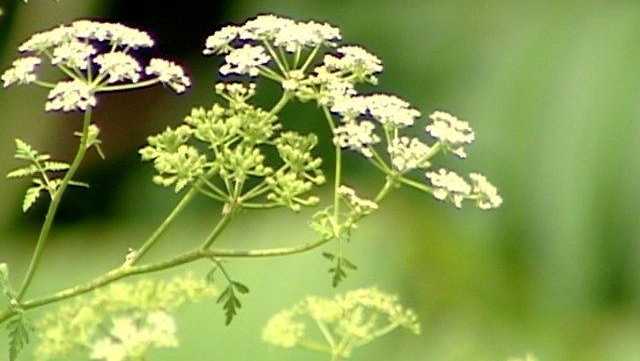
What should you look for? Boggs said poison hemlock produces white flowers on stalks that create a more rounded look – like an umbrella. These plants have bluish-green leaves. The deeply cut parsley-like leaflets have sharp points.
Flowering plants have hairless, light-green to bluish-green stems that are covered with obvious reddish-purple blotches. But, the blotches may occasionally coalesce to cause stems to appear an almost solid color, according to Boggs.
WILD PARSNIP
Wild Parsnip can cause severe, painful blistering, Boggs said in an article for OSU.
The weeds are commonly found growing alongside poison hemlock.
Wild parsnip has intense yellow flowers with the stalks producing a more flat-topped appearance.
Wild parsnip plants have leaves that look vaguely like celery, another member of the carrot family. Mature plants have a single, thick, deeply grooved, greenish-yellow stem that sprouts lateral branches topped with flowers, Boggs said.
Wild parsnip can cause severe blistering called phytophotodermatitis, also known as Berloque dermatitis, Boggs said, and can cause burn-like symptoms when exposed to the skin. It can also cause skin discoloration that may last for several months, the educators said in the article.
Blistering can appear 24 hours after exposure and doesn't peak for another 48 to 72 hours, the article said.
Boggs said the poisonous nature of the plants means they should not be allowed to grow where they can be easily contacted by people but mowing, weed trimming or hand-pulling can be problematic. Mowing can cause the plants to be exposed to the skin of those operating the mower.
To learn more, click here.
Source link