

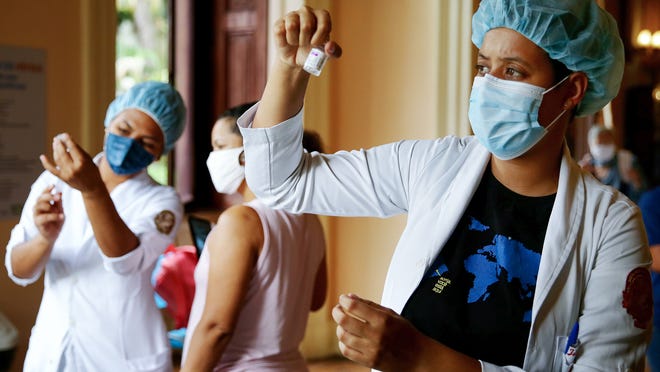
Moderna announced Thursday that it has requested an "emergency use authorization" from the Food and Drug Administration for its COVID-19 vaccine for kids ages 12-17.
The Pfizer/BioNTech vaccine already has won FDA authorization for kids as young as 12. Providing access to vaccines for children is a crucial component in the effort to normalize in-classroom learning for the 2020-21 school year, little more than two months away in some school districts.
Moderna, which previously filed for the adoltescent authorization with Health Canada and the European Medicines Agency, said it plans to file a similar request with agencies around the world.
"We remain committed to helping to end the COVID-19 pandemic," Moderna CEO Stéphane Bancel said in a statement.
Also in the news:
►Two passengers on board MSC Cruises' MSC Seaside ship tested positive for COVID-19, disembarking Tuesday during a scheduled port call in Sicily, Italy. MSC cruises has been sailing in Europe on and off since August.
►Ohio has two more Vax-a-Million winners: Mark Cline from Richwood in Union County won $1 million and Sara Afaneh from Sheffield Lake in Lorain County won a four-year college scholarship, the Ohio Lottery Commission announced Wednesday night.
►Johnson & Johnson's COVID-19 vaccine triggers several types of immune responses, a new study shows, allowing it to be extremely protective in the United States as well as in South Africa and Brazil, where a handful of different virus variants are circulating.
►Australia’s second-largest city Melbourne will emerge from its fourth pandemic lockdown Friday. State officials say the lockdown is being ended after two weeks following only one new coronavirus case being detected in the latest 24-hour period.
►Philadelphia will end its indoor mask mandate and the 11:00 p.m. last call for restaurants Friday.
►California will follow Centers for Disease Control and Prevention mask guidance for vaccinated people when it lifts its mask order on June 15, state health officials said Wednesday.
►Iowa won't allow its residents to see their vaccination histories or those of their children on the state website anymore, saying it wants to prevent employers from checking on their workers' vaccination status without permission.
? Today's numbers: The U.S. has more than 33.6 million confirmed coronavirus cases and at least 598,700 deaths, according to Johns Hopkins University data. The global totals: Over 174.3 million cases and over 3.75 million deaths. Nearly 140.8 million Americans have been fully vaccinated – 42.5% of the population, according to the CDC.
? What we're reading: As Americans get vaccinated against the coronavirus, a report published Wednesday found teens and adults may have missed millions of routine vaccinations recommended by the CDC in 2020.
Keep refreshing this page for the latest updates. Want more? Sign up for our Coronavirus Watch newsletter for updates to your inbox and join our Facebook group.
Hold the fireworks: Biden vaccination goal for July 4 could be out of reach
President Joe Biden's vaccine goal for America – 70% of adults receiving at least one COVID-19 shot by the Fourth of July – is starting to look like a long shot. If jabs continue at their current pace, Biden will fall short of that benchmark. In the past week, an average of about 365,000 adults have received their first vaccine each day. To reach Biden's goal, that number will need to increase to about 630,000 adults newly vaccinated each day. The pace of vaccine administration has fallen significantly from its peak in early April, when more than 2 million adults were reported newly vaccinated each day.
– Janie Haseman
Pfizer and BioNTech to donate 500 million vaccine doses
Pfizer and BioNTech announced plans Thursday to donate 500 million doses to the U.S. government to distribute to 92 low-income countries and the African Union. The news confirms Wednesday's report of President Joe Biden's upcoming announcement to the G-7 summit. Vaccine inequality has become an increasingly pressing concern, and the World Health Organization has warned of a "two-track pandemic'' as wealthy nations inoculate large portions of their populations and developing countries are left exposed to the coronavirus' ravages.
In a June 3 report, Oxfam International said that of the 1.77 billion doses administered worldwide to that point, 28% had gone to people in G-7 nations and only 0.3% to low-income countries. Such disparity could prolong the pandemic and allow for dangerous variants to emerge as the virus continues to spread.
Add DC hospitals to growing number that require employee vaccinations
Most hospitals in Washington, D.C., will require employees to receive the COVID-19 vaccination, joining a growing number of health care systems and other businesses nationwide in opting for the controversial mandate. The hospitals will each set their own deadline, the District of Columbia Hospital Association said in a statement Tuesday. Vaccine hesitancy has slowed progress in getting the nation jabbed, and some health care systems and other businesses are trying to reawaken vaccination momentum.
Jacqueline Bowens, president and CEO of the District of Columbia Hospital Association, said the "consensus is a reiteration of our hospitals’ commitment to safety by keeping our staff, patients and visitors protected against COVID-19.”
Hundreds of thousands of Johnson & Johnson vaccines could be wasted
Slowing demand and the lingering effects of a 11-day pause on the Johnson & Johnson COVID-19 vaccine mean states have hundreds of thousands of doses that may expire before they can find willing arms. That's changed in the past month. As of Wednesday, Arkansas alone had 3,271 doses of unadministered J&J vaccine. Of those, 42,971 expire on June 23 and another 10,042 expire on July 4, the Arkansas Department of Health said. In Ohio, the governor has warned 200,000 J&J doses will have to be tossed on June 24 if they don't get takers.
"When we had more demand than the supply could meet, expiration dates weren't a problem. Vaccine was being used up as fast as it came in the door," said Dr. Kelly Moore, deputy director of the Immunization Action Coalition.
– Elizabeth Weise
California regulators withdraw controversial work mask rules
California’s workplace regulators have reversed themselves for the second time in a week. They withdrew a controversial, pending mask regulation late Wednesday. That will give them time to consider a rule that more closely aligns with Gov. Gavin Newsom’s promise that the state will fully reopen from the pandemic on Tuesday.
The California Occupational Safety and Health Standards Board’s revised rule would have allowed workers to forego masks only if every employee in a room is fully vaccinated against the coronavirus. That contrasts with the state’s broader plan to do away with virtually all masking requirements for vaccinated people in concert with the latest recommendations from the CDC.
The goal, said board chairman David Thomas, is to change the workplace regulation “so that it matches up with the CDC and the California Department of Public Health, so that we’re all on the same page. That’s what this is about, so we’re not out of step with everybody else.”
Seattle, San Francisco take their shots as top major cities for vaccinations
Two West Coast cities are in a neck-and-neck race for the country's top vaccination status, and each may have a claim on holding the lead. Seattle Mayor Jenny Durkan said Wednesday hers is the first major U.S. city with 70% of its residents 12 and older having completed their COVID-19 vaccinations, edging San Francisco by a percentage point.
“Now that we have reached community protection, we can lead the nation in safely reopening and recovering in earnest,” Durkan said in a statement.
However, San Francisco is slightly ahead with the nation's best rate of residents 12 and above who've had at least one vaccine shot, 79-78%, and could inch ahead in the race for herd immunity.
“I do believe we are on track to be the first city to achieve herd immunity,” Dr. Monica Gandhi, an infectious disease expert with the University of California, San Francisco, told the San Francisco Chronicle.
"Our high rates of immunity means we are not susceptible to new infections even with travel here,” she said.

Contributing: The Associated Press